|
|
Strategy
Experiments will take place in beech stands both in the Ardenne and in the Forêt de Soignes, south of Brussels. We will study scolytid species involved in beech decline (Trypodendron domesticum, T. signatum, Xyleborus dispar) as well as an invasive asiatic species (Xylosandrus germanus) (10, 11).
1. A study of beech susceptibility to frost
Temperate trees have developed a cold hardening mechanism, consisting in morphological and physiological changes allowing an increased resistance to winter low temperatures. Mechanisms of cold hardening will be studied in the greenhouse and in the field.
In the greenhouse, the impacts of various factors (temperature, photoperiod, N nutrition, water availability, defoliation) on the level of cold resistance will be assessed.
In the field, seasonal variation of the level of freezing resistance will be determined, by mean of electrolyte leakage method. This method consists in measuring the cell solution conductivity due to ion liberation by frost-damaged membranes. The influence of stand characteristics (soil, topography…) will be assessed.
In another field experiment, we will subject beech trees to a severe summer drought and assess the impacts of the treatment on frost resistance during winter, and on tree attractiveness for insects during next spring.
Analysis of data collected during the sudden beech decline will be performed (damage intensity as a function of stand characteristics).
2. Link between frost and scolytine ambrosia beetle outbreak
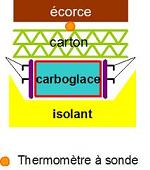
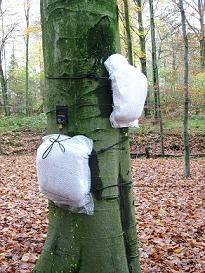
Frost related injuries will be artificially inflicted to beech trees in the field, by application of different cold levels on the bark, using carbo-ice. Trees vigour will be estimated by foliage appearance.
Beech attractiveness to scolytids will be studied by using interception traps established at the base of the trees. Volatile substances produced by necrotic zones will be identified, after trapping on adsorbant substrates, by gas chromatography and mass spectrometry (GC-MS). The biological activity of these molecules on insects will possibly be tested by electroantennography (GC-EAD).
Beech susceptibility to insect attacks will be estimated by the colonization success of scolytids caged on the trunk. The symptoms developped by the trees will be followed up closely during the four year study, by anatomical analyses of phloem and sapwood tissues.
3. Secondary insect outbreaks on healthy trees: a phenological problem?
A problem of synchrony between insect flight and the building-up of tree resistance to insects following bud flushing in spring could perhaps explain why secondary beetles have recently become successful in attacking healthy trees. Whilst the emergence of hibernating adult beetles in spring is mostly thermo-dependant, bud flushing and the starting of physiological activity in trees rather depend on photoperiod. Therefore, one cannot discard the possibility to have insects establishing on healthy trees when early spring is sufficiently warm (14).
In order to test this hypothesis, we will expose beech trees in the field to early attacks of scolytids, and measure these latter's establishment success. Scolytid flight phenology will be followed during the four year study and analysed with regards to climatic data.
|

|
