Context
The aim of this project is to contribute to a better understanding of the impact climate changes have on tree vulnerability to insect outbreaks.
Global climate changes are, in many locations worldwide, thought to be at the origin of an increase in the frequency, intensity and duration of dramatic climatic events. Drought, flooding, warm waves, sudden temperature falls and storms expose forests to considerable stresses, resulting in a global weakening of forest trees. As a consequence, insects which used to be considered as secondary have become able to attack healthy trees, and represent therefore a new threat for forests worldwide. A most recent illustrative example is the sudden beech (Fagus sylvatica L.) decline which has taken place in the south of Belgium in the early 2000s.
Sudden beech decline in Southern Belgium and surrounding regions
Beech stands in South Belgium have suffered, in the early 2000s, from a steady decline, puzzling by its geographical extent, gravity and suddenness. Bark exsudations and necroses broke out on the trunks, along with fungi and the appearence of xylophageous insect galleries (the ambrosia beetles Xyloterus (=Trypodendron) spp., Xyleborus (=Anisandrus) dispar). These insects are generally considered secondary, normally appearing on weakened or dead trees. A total of 1.3 millions m³ of timber has been affected. Eventually, a great number of these trees survived, and were able to recover from these injuries.
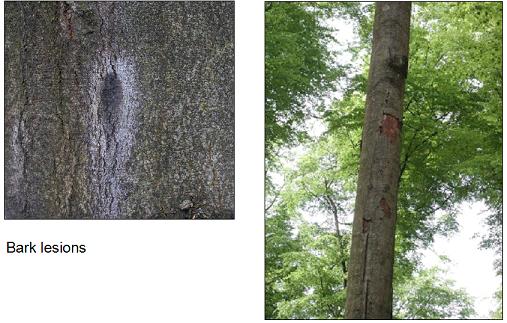
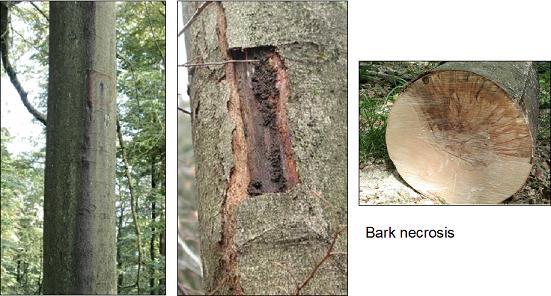
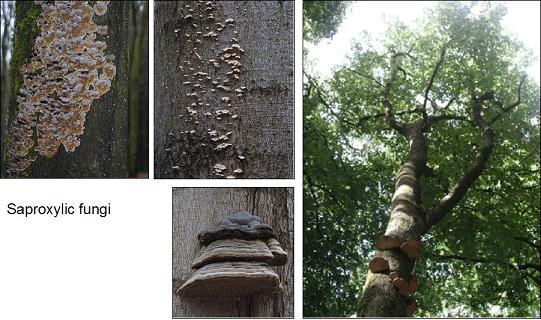
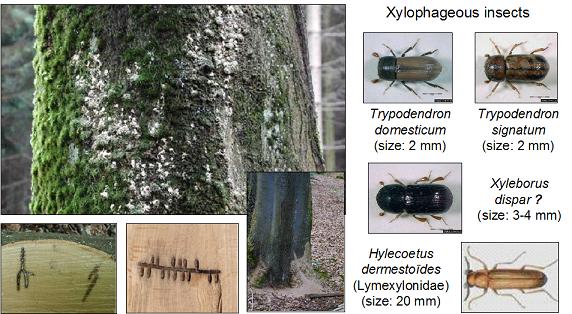
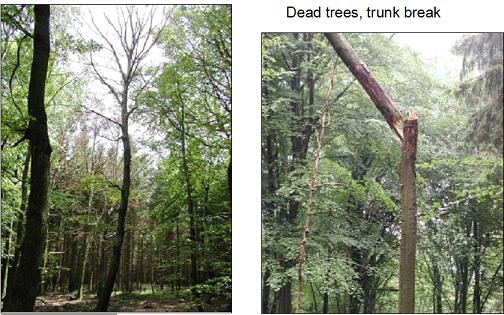
Image source : http://www.interreg-buche.de/
The cause of this event remains today extremely hypothetical. The hypothesis of a
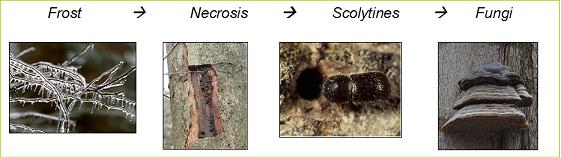
sudden cold wave in November 1998 affecting trees not yet prepared to winter conditions is highly supported by meteorological (sudden drop of temperature in mid-November 1998), and symptomatological observations (damages correlated with altitude and wind exposition, suddenness and non specificity to any particular species, similar damages being reported on
Acer pseudoplatanus).
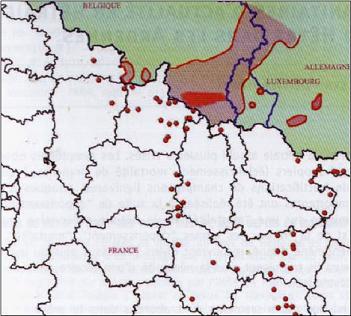
Geographical extent of sudden beech decline. Source : Nageleisen and Huart 2005.
The most likely interpretation of this phenomenon is that freezing-related necrotic tissues both on large and on limited areas (microcrevices) of the tree surface did produce ethanol, a substance which could possibly have attracted the scolytid beetles. The colonization success of these secondary insects could therefore be related to a general decrease of tree resistance due to global climate change.
Similar problems on beech trees were previously reported both in the Ardenne (Belgium) and in the Vosges (France) areas, respectively in the 40’s and the 80’s. No one could therefore discard, at this stage, a possible re-occurrence of this phenomenon in a near future.

