|
|
Goals
The impacts of different climate events on beech-scolytine ambrosia beetle relationships will be assessed.
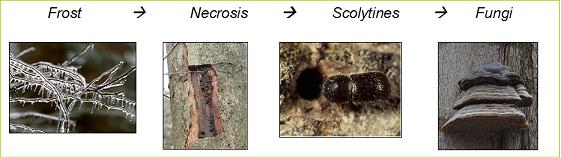
1. Beech susceptibility to frost
What is the range of frost temperatures supported by beech ? How does this resistance level vary during the season (autumn – winter – spring) ? Is beech cold hardiness temperature-dependant and/or photoperiod-dependant ?
Beech forests usually suffer from multiple stresses linked to stand conditions, as atmospheric pollution, Ca and Mg deficiencies, soil acidity and compaction, and to climate conditions (drought, storms, …). These induce tree decline, with crown reduction, branches mortality, and a global weakening of trees.
Is there a link between this decline and an increased sensibility of beech to frost ?
Can a severe summer drought reduce tree resistance to frost ?
2. Link between frost and scolytine ambrosia beetle outbreak
Ambrosia beetle attacks were observed on apparently healthy trees, but they were concentrated in bark necrosis. Are these zones particularly attractive for the insects (by the production of fermentation products as ethanol) ? Are they favourable for host colonization ?
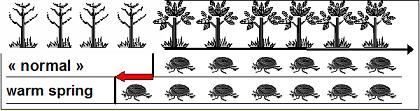
3. Secondary insect outbreak on healthy tree : phenological hypothesis
Kühnholz et al. proposed a phenological explanation of secondary insect outbreaks on apparently healthy trees. Unusually spring warm temperature can induce insect emergence (temperature-dependant), when trees are still sensible to insects (photoperiod-dependant).
Would it be possible for the ambrosia beetle-beech association in Belgium ?
An experimental approach was chosen to answer these questions.
|

|
